How to choose an adventure bike
Lessons learned from the four bikes I’ve adventured with.
What is an adventure bike?
The bike industry likes to think it is in continual flux. How else would they sell apparently new stuff all the time and enable publishers to fill pages of glossy magazines with essentially the same gear year after year.
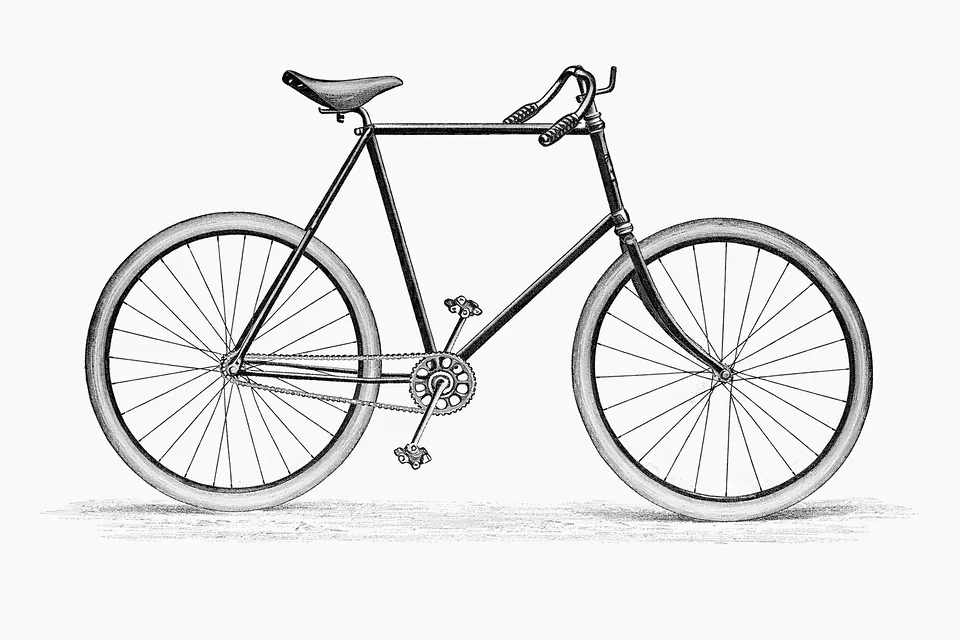
However, they rarely make any significant changes in their products: the last proper change was almost 150 years ago with the introduction of central pedals and the diamond frame.
So if bikes haven’t really changed then what’s an adventure bike? Its more about the bike’s purpose rather than the bike itself. Each person’s adventure bike is unique because your own adventures are. Also, if you travel enough on a bike, adventure will find you. For me adventure came from constantly pushing myself a little (and sometimes a lot) beyond my ordinary day-to-day: a big part of that is exploring off-road trails around Europe.
How I found a bike that worked for me.
Its taken almost 20 years, but I’m now pretty comfortable with my ability to find a bike that works for me. Below are the steps I took:
- Using a city bike
- Mistakenly buying a “hybrid fitness” bike
- A proper gravel bike
- The ultimate adventure bike
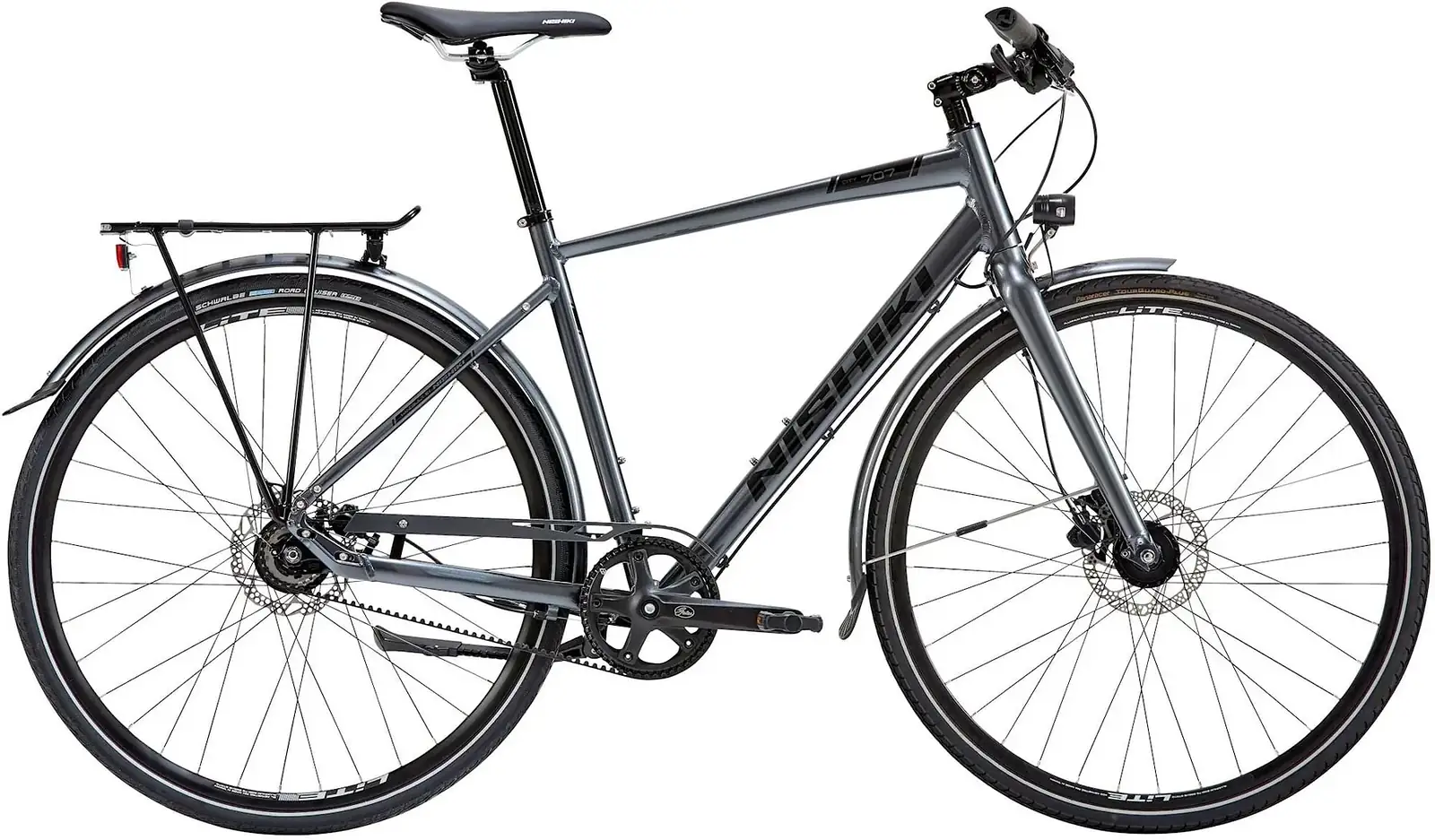
1. Reusing my city bike: Nishiki City
I first started “gravel biking” around 2010 when we moved our offices out of Copenhagen. I was lucky because it wasn’t too far to stop me from thinking “I could cyle home from time to time instead of taking the train”. Depending on the route it would be anywhere between 15km and 30km, a fine starter distance.
I had no idea what to expect, I wasn’t particularly fit, but I just started by reusing my standard city bike (almost everybody in Denmark has one of these).
My first trips were along the cycle paths by the main road, safe and very appropriate for the bike, but rather grim breathing in the traffic fumes. Since these were the early days of Google Maps and certainly well before any Komoot or other ride planning tools I just followed local pamphlets, matching them to the rough satellite position on Google Maps, plotting out a series of “saved points” to check on my phone whilst I cycled.
Turns out the bike was relatively ok for the mix of relatively smooth gravel and cycle paths.
Pros
- Cheap since it was my existing bike
Cons
- Not built for lots of off-road: started rattling and generally getting “looser”. Lesson learned: Get a bike designed to the job you’re using it for.
- Rear brake was a hub brake which meant stopping power not great and you couldn’t “pedal backwards to give your legs something else to do”. Lesson learned: Get independent front/rear brakes.
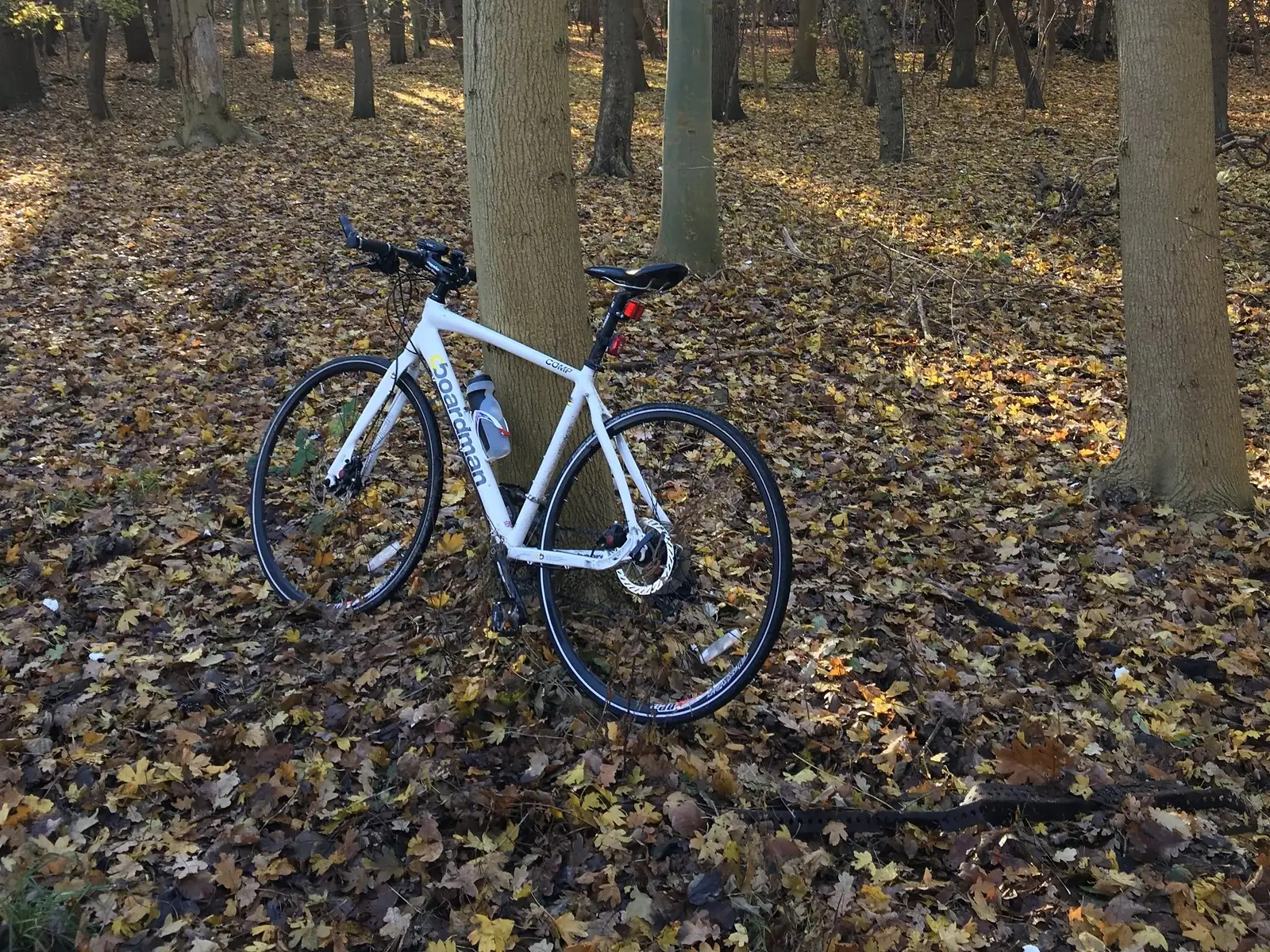
2. My second adventure bike was a mistake: Boardman Hybrid Comp
In 2013 I got tired of the rattling old city bike and bought a new bike that I thought would work well for relatively straightforward gravel commuting and bits of double track at the weekends: Boardman Hybrid Comp.
- A lot faster than the previous bike, probably the geometry, the weight, my progress, etc. Most of my “personal bests” on Strava are still from this bike.
- At the time I didn’t think it was super cheap at £500 / 5000 DKK.
- The thin tyres were not great off-road. Perhaps they could have been replaced with something a little wider, though at that point I did think that wider tyres would be more effort to pedal. Lessons learned: 1) Thin tyres fall into every rut off-road and can be a bit dangerous 2) Thin tyres don’t hold much air and need to be at relatively high pressures: they are inherently uncomfortable off-road.
- The riding position was completely wrong for me. I often got neck pain after about 30km. Lesson learned: Choose a bike with more upright position.
- I thought it was heavy: by this time I’d started on wilder rides and occasionally would need to lift it over a gate or similar. Lesson learned: Be able to lift your bike above your head.
- The gear cable snapped on me a couple of times leaving 20km or more in a slow gear. Lesson learned: Reduce the chances of “things” failing (maintenance, choose different/better/fewer “things”)
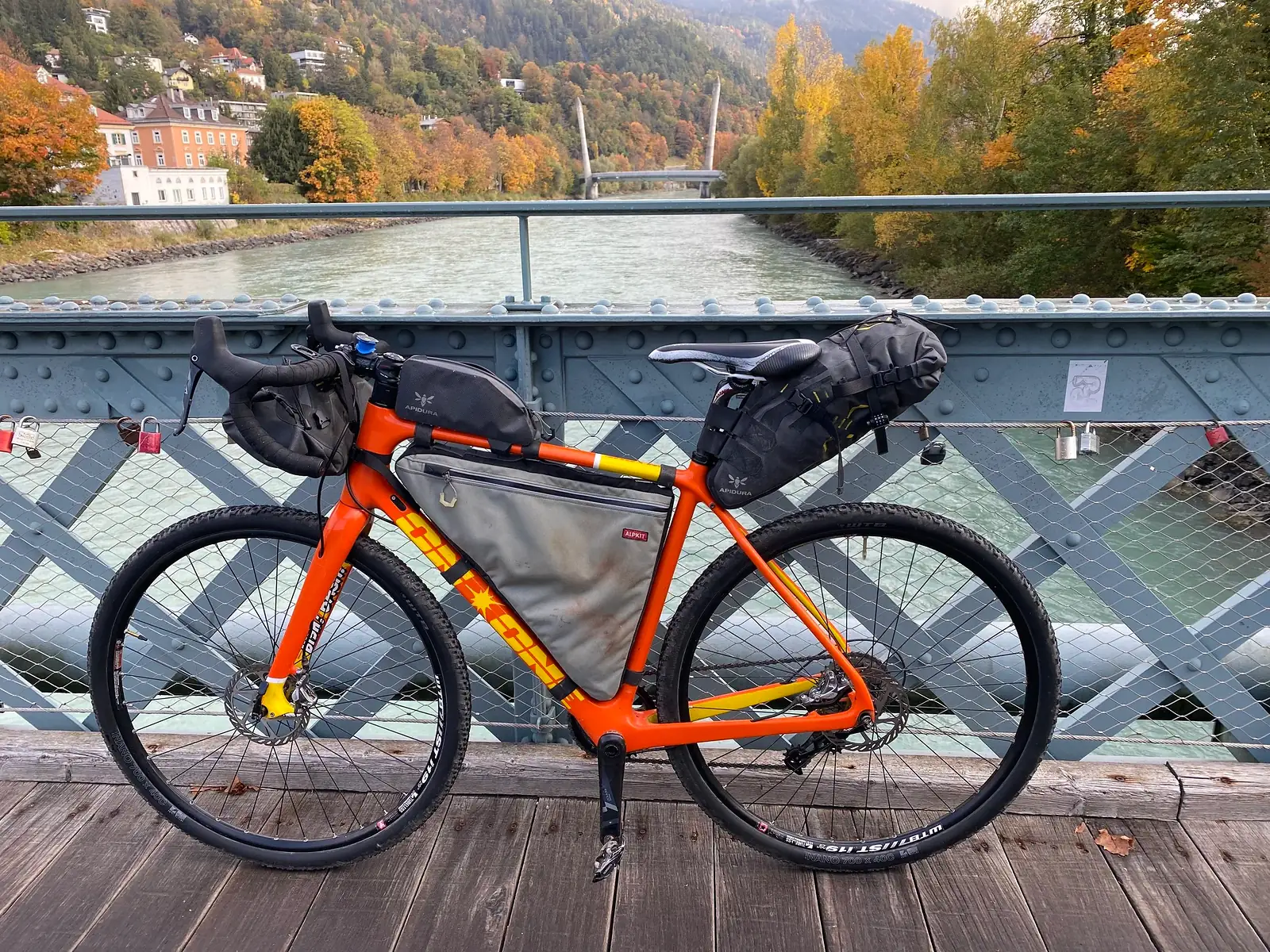
3. Third time lucky: On One Bish Bash Bosh, a great gravel bike
In 2017 I started to think about taking a longer trip, perhaps a week or so away from home. So I needed a bike that could manage that.
I went for the On-One Bish Bash Bosh, a faintly ridiculous name and in a ridiculous colour (it was on offer as an ex-demo bike). It was very well kitted out and a very good price.
- It was all carbon and incredibly light; even with a set of bags it was possible to get it over my head with one arm. It really made a difference in some places where I was a little too adventurous. I also remember picking it up and using it as a scythe on at least one overgrown path in France.
- Very smooth and reliable gear shifting and really powerful consistent feeling hydraulic disc brakes: SRAM Force 1. Lesson learned: When you’re on long rides, how everything feels is a big benefit.
- The quality of the components seemed to make maintenance a lot simpler. I often cleaned the chain, replacing it myself on occasions. But I also looked after it with a professional bike shop once in a while. Lesson learned: Higer quality gear prompted me to look after it: “this could last a lifetime”.
- I loved the 1x (only a rear derailleur) gear system, it was so simple.
- I travelled a lot with this bike on planes and trains. Whenever it had to go in a bag it didn’t take too long to take apart. I loved the thru axels, they feel so secure and solid, yet can be taken out in 30 seconds. I always felt the derailleur was especially vulnerable but never had issues and always carried a spare hanger.
- The biggest issue for me (because I’m quite an ordinary rider) was the gear ratios… any slope over about 11% was largely off-limits if it went on for more than a hundred metres or so. Lesson learned: If you want to go “anywhere” you need to be ready for steep slopes.
- I loved the carbon frame and fork. It made the bike a joy to ride and take anywhere. However I was always a little worried on some more extreme trails where it got bumped and shook up. Would it break at some point? “Catastrophic failure” are the words no cyclist wants to read.
- It got stolen. I think one of the reasons that it was stolen was because it was a good quality gravel bike and I guess they were easy to “move on”. Lessons learned: 1) Getting the fanciest looking thing can make it more of a target for thieves 2) A good insurance policy is an important starting point
4. Even the ultimate adventure bike has trade-offs: Nua Roure
The theft of the Bish Bash Bosh in 2023 meant that I needed a new bike. It was time to really think about what I wanted. So I started with why.
Adventure biking needs list
- Where was I going to use the bike? Anything from my local forests (20 to 100km) to long distances (around 800km in 2 weeks, with long term thoughts to do more) across Europe.
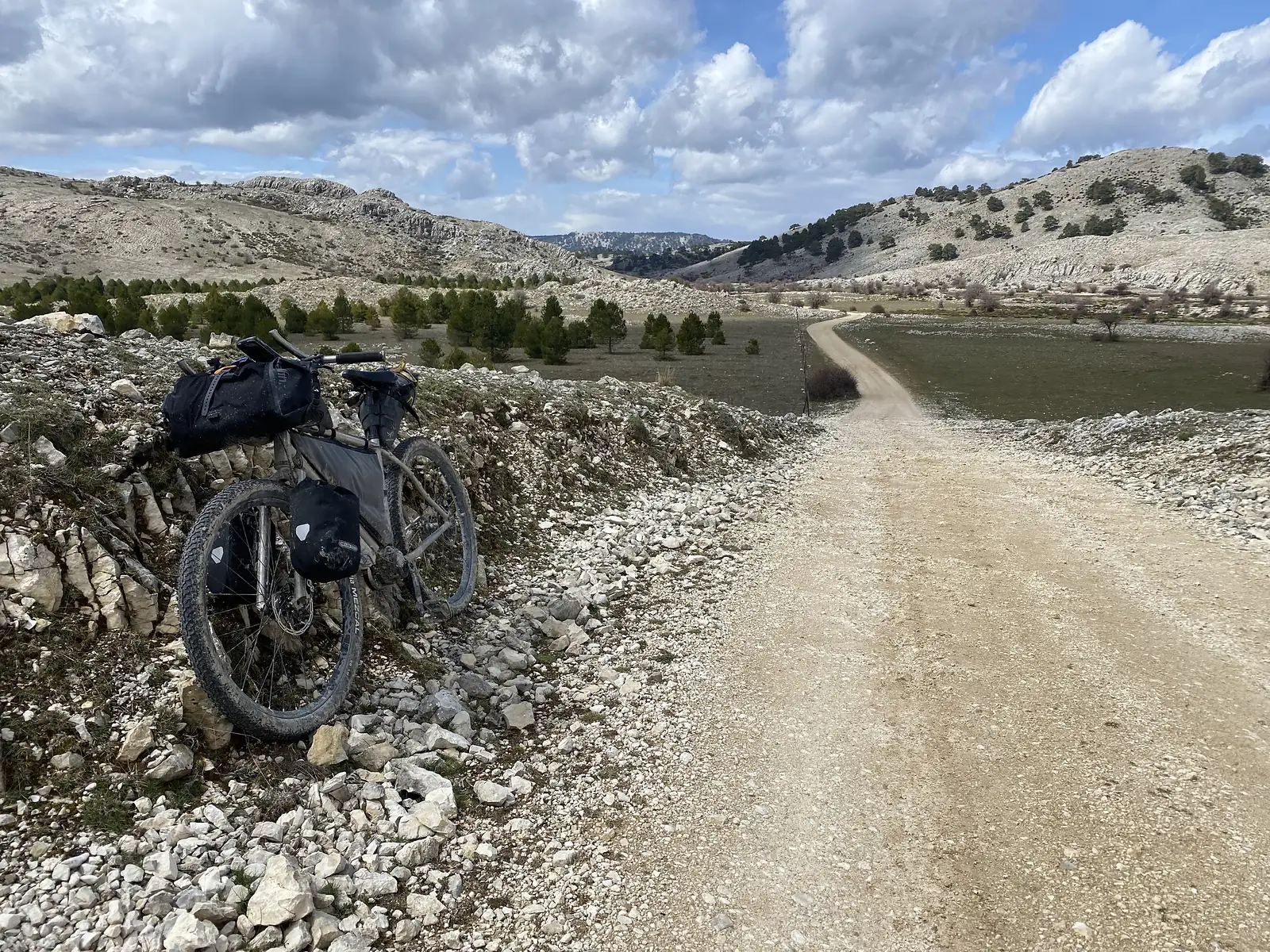
- At least 50% off-road. Mainly double track but frequent single track and certainly the occasional pushing. Surfaces are anything from smooth asphalt to chopped up boulder fields.
- There will be steep gradients on those varied surfaces. This applies almost as much to going down as to going up.
- I’ll cycle mainly in the dry. Easy to do at home, but on longer trips it will almost always rain at some point. I’ve cycled in all temperatures from -15°C to +42°C. It needs to cope with almost any weather and the consequent trail conditions.
- Related to where is how to get the bike to/from destinations around Europe. Wherever I can, I use the train. Ideally I’ll book a cycle place, that way there’ll be no disassembly. However there’s many places that are either too far away (e.g. Portugal) or not served by trains with bike places (almost all high-speed rail in Europe). I need to be able to transport it quickly and easily on trains and planes, and that means some disassembly.
- My riding style is slow enough to see every leaf on a tree, but fast enough to see the landscape change in a day. My average speed on the long distance off-road trails is around 13km/h. I plan never to spend more than 8 hours a day cycling (my current longest ride is almost 7 hours moving time).
- On occasions I’ll need to carry full camping equipment and plenty of food. I’ll spend nights in the middle of nowhere, but almost always will be able to find more food the next day (except for Sundays in half of Europe).
- I’m not a mechanic. I want to be pretty certain I can travel at least 1000km on a pre-serviced bike without any external help.
Adventure bicycle feature list
Building on the lessons learned from the previous three bikes and applying them to the needs above I reckoned a good feature list for my ultimate bike would be:
- Built for punishment on lots of gnarly off-road and steep ups and downsPinion gear box - internally geared (nothing at risk of breaking if hit rocks etc.), very low ratios (even I can now go up most slopes up to the high teens)
- Good brakes - if you’re going up steep slopes you want to be sure you’re going to stop when you’re going down them
- Big tyres - good grip from the surface area
- High ground clearance - so that you can navigate off-road without hitting stuff
- Strong frame - because it is going to take some punishment over the years
- Yet rides like a Rolls RoyceBig tyres - and wheels. 29 inch. diameter. At least 2.35 inches wide.
- Upright geometry - I’ve had neck pains too many times, I need to be upright for long days
- Swept handlebars with multiple positions - I loved the “hoods” of drop bars, but never used the bottoms. I want swept flat handlebars with my hands in a more natural position but with plenty of alternative positions.
- Suspension stem - really helps with fatigue if you’re off-road a lot
- Comfortable saddle
- Suspension saddle post - would this be worth the extra weight?
- Lightweight frame - again for the ride feel, I loved carbon previously and titanium could of course be an option
- High end gears - they should change so smoothly that you can hardly notice, I really looked hard at electronic shifting too
- Good brakes - here is mainly about the feel of brakes… when do they start to bite, how smooth is the progression as you apply power.
- Lightweight (for hike-a-bike, also around stations/airports), Lightweight frame - this would really have to be carbon or titanium
- Avoid heavy extras e.g. suspension forks, internal gearboxes, dynamos, suspension stems and seat posts
- Can be assembled/disassembled rapidly, Pinion/Gates - much easier to manage than a derailleur or Rohloff
- Thru axles - I just prefer these to quick release as they just feel proper
- Avoid too many frame add ons e.g. carrying racks
- Small travel footprint - I looked at folding bikes and the Rinko bike concept but they felt simply too complex. I think it might work for touring bikes but not adventure bikes. Instead I’d be happy just with the speed and ease of getting the handlebar and wheels dismounted and secured.
- Can carry tons of stuffLots of mounting points
- Big frame area
- Handlebar configuration allows for bags to be attached without interfering with brakes, gears etc.
- Takes almost 0 maintenance and will never fail. Pinion/Gates is about as close as you’ll get for a “low risk” drivetrain
- Tubeless - I’m now fully converted to this, it really does avoid punctures
- Mechanical brakes - the old mechanical vs hydraulic disc brake debate is a tough one, serious problems with hydraulics aren’t going to be easy to fix but then again I’m in Europe and most places will be able to fix them.
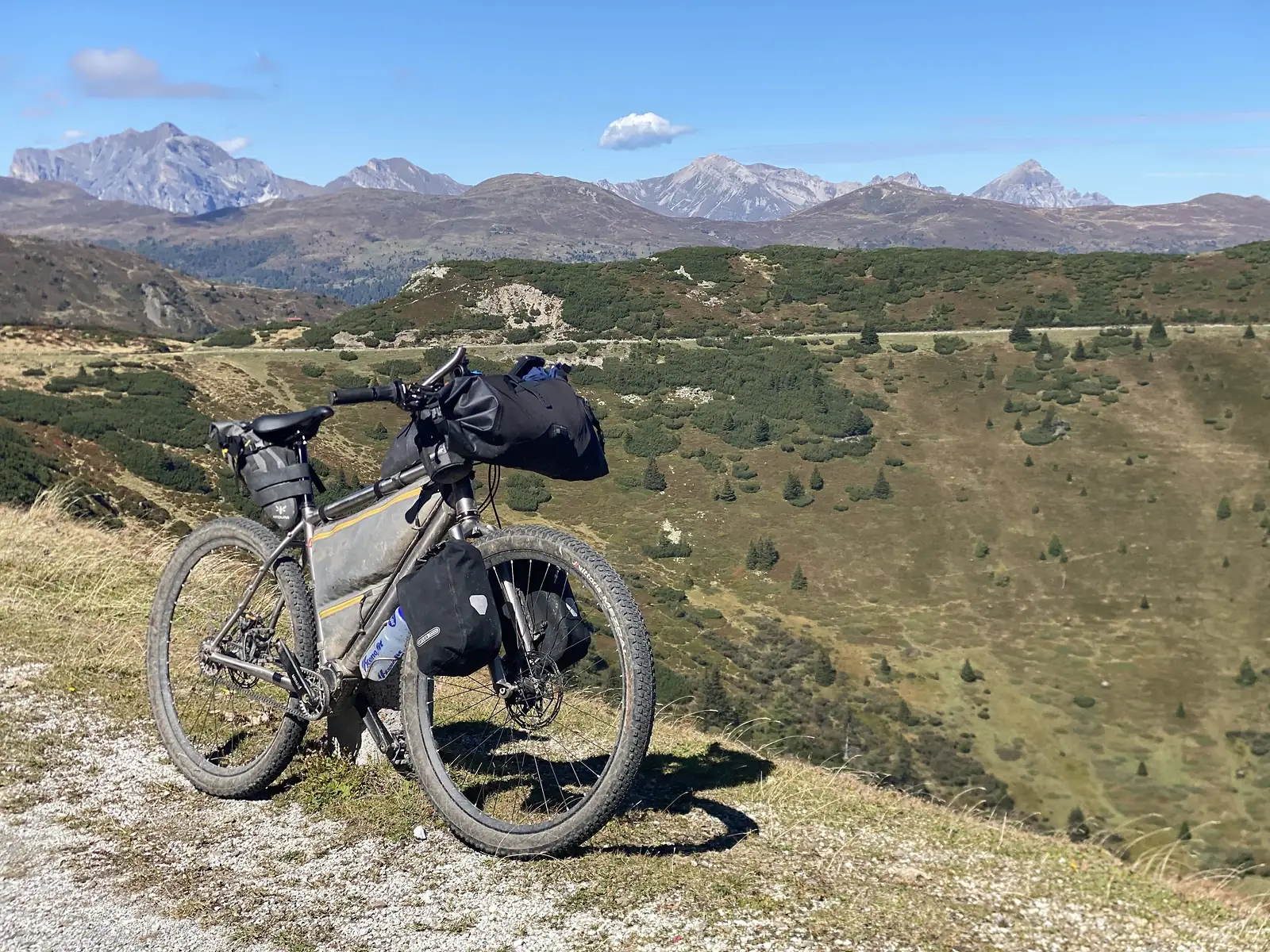
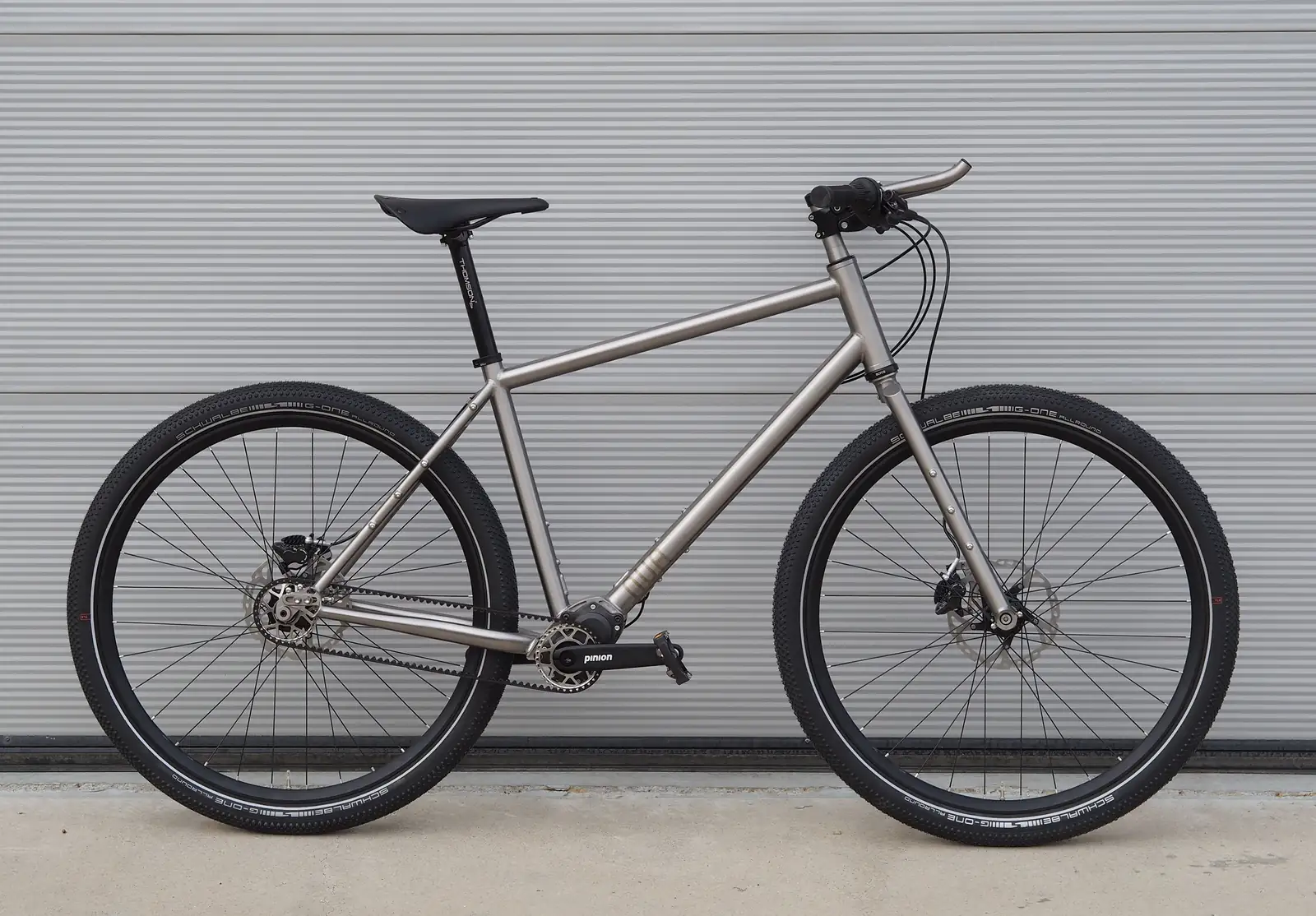
Taking that into account I went for an custom geometry titanium bike from a small Catalan builder, Nua. It many ways it is like an old fashioned mountain bike upgraded for the 21st century. For me, the Nua Roure is about as close as I could get to the perfect all terrain bicycle (ATB):
- Frame and fork: Titanium Gr.9 Ti-3Al-2,5V Oversized tubing. Tyre clearance: 76mm-584 (27,5" 3" PLUS) and 61mm-622 (29" 2,4"). Mounting holes for mudguards, rear rack, 3 bottle cages and 3-Pack on seat stays and forks.
- Drivetrain: Pinion C1.12 Gearbox // Speeds 12// Overall Ratio: 600% // Pinion DS2 Rotary shifter. Pinion Forged Cranks 170mm. Shimano XT PD-T8000 pedals (hybrid SPD/flat). Gates CarbonDrive CDX.
- Brakes: Shimano XT-M8020 4 piston hydro brakes with 180mm rotors.
- Wheels: DT Swiss EX471 rims (ETRTO 622/700C/28"/29"). Robert Axel Project thru axles.
- Tyres: Schwalbe G-ONE Allround Snakeskin 2,25"/57mm wide (ETRTO622/29")
- Handlebar / Stem. Nua Toro Loco titanium handlebar (775mm wide, 25deg sweep, horns at 350mm) with 90mm Kinekt suspension stem. Brooks Cambium Comfort grips.
- Seating: . Brooks Cambium C17 saddle and Thomson Elite seatpost
- Dynamo: SON 28 dynamo front hub with CinQ The Plug V Pure USB charger.
I’ve now ridden this bike for many thousands of km and it remains amazing. It is so good that at times I actually want to go out and ride (I suspect that like most ordinary people I don’t really want to exercise, I just know it will be good for me if I do it).
- The overall feel and build of this thing is amazing. From bouncing down single track feeling in complete control to the absolute smoothness of the machine on asphalt. It is so easy to cycle that it feels like an electric bike at times; I’ve often thought of checking if there’s a hidden motor.
- Big tyres are an absolute must have. Longer trips are so comfortable with them absorbing much of the roughness (though of course this depends on what pressure you run them at and that is difficult when you’re constantly transitioning between roads and off-road).
- Tubeless has meant no punctures (yet) after thousands of km.
- I feel very comfortable taking it apart and putting it together, knowing it will work. The Pinion/Gates combo definitely helps but also the quailty of everything from the thru axles to the handlebar bolts. Lesson learned: get quality components if you’re taking them apart a lot.
- Carrying capacity. There’s plenty of points and space to mount lots of bags and even bike racks. I’ve carried full bikepacking gear (tent, cooking, sleeping, clothes etc.) for long distances with no great change in how the bike feels.
Cons (… and these are very minor and more about continued learning)
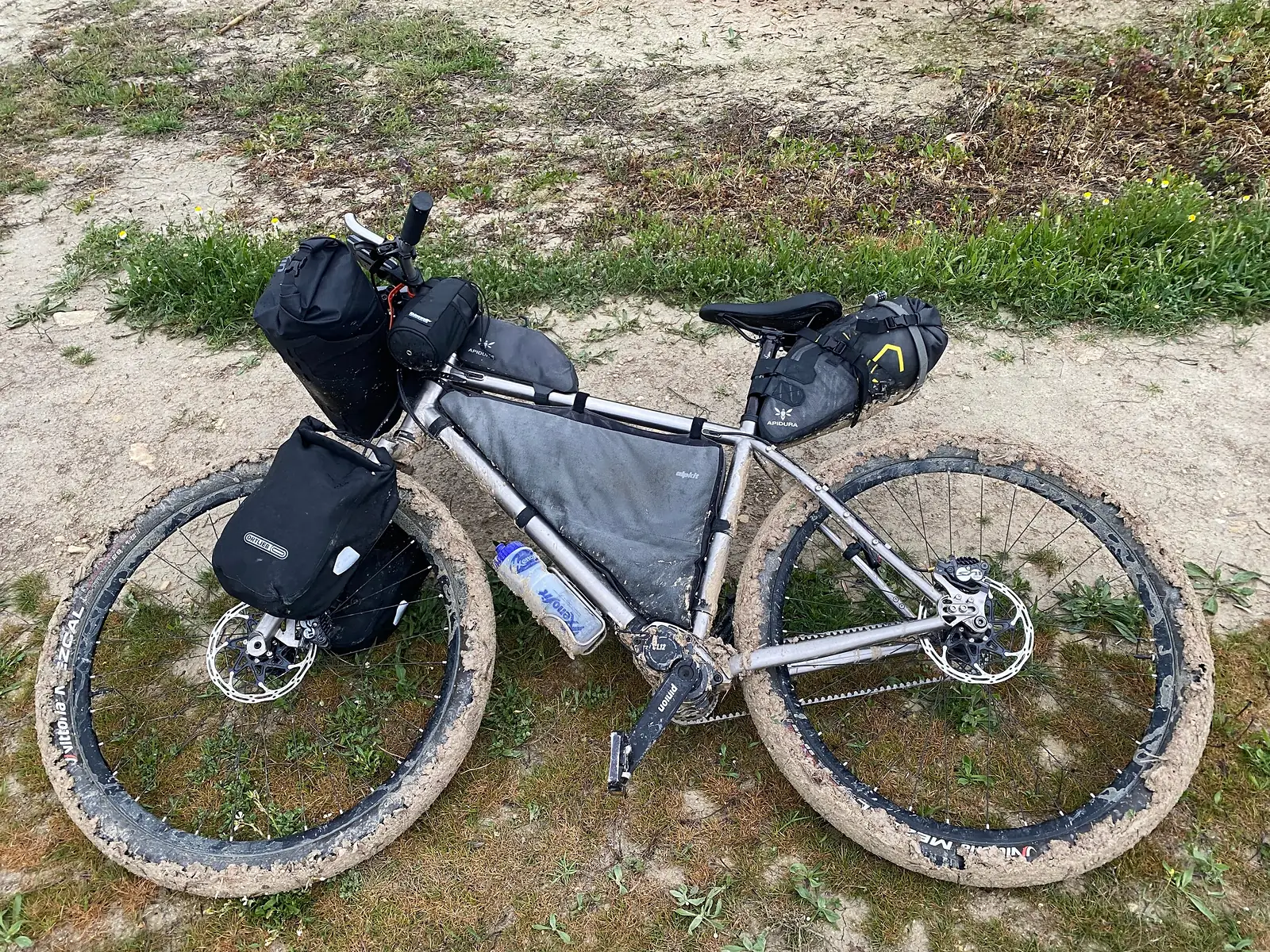
- The Snakeskin tyres are fine on standard double track and asphalt but I found they lost some grip on looser stuff so when they wore out I swapped them for Vittoria Mezcal XC Trail 29" TLR MTB Graphene 2.0 Folding Tire 29" x 2.35 / 57-622.
- Gates Drive. I had a Gates belt snap on me about 25km outside of Cordoba. I didn’t take a spare (thinking “these things should last 100,000km”). There’s no spares in the south of Spain (Gates not much used compared to e.g. Netherlands) but luckily the guys at Nua up in Catalonia got me one within 24 hours. Lesson learned: even the most solid components have weaknesses, carry spares.There is a known issue with Gates belts: if you’re really adventuring, things will get stuck in the drive train, potentially moving the belt off the teeth of the sprocket (front/rear, usually front) leading to untracking where the belt comes off. I’ve had this happen with sticks and stones getting stuck (Hint: ANY resistance in the drive train then STOP immediately and sort it out; because Gates/Pinion is so smooth you’ll notice it very easily). I had a couple of episodes where the belt got dislodged but many hundreds (thousands?) of km before the snap happened. I understand it can lead to some of the carbon chords snapping/stretching and a consequent reduction in tensile strength which ultimately leads to a sudden catastrophic failure.
- Bottom line: if your Gates belt gets dislodged then replace it as soon as possible or you risk a sudden failure. I now always carry a spare inside my framepack so that it isn’t crimped in any way.
- The other option is of course to run a chain with the Pinion. The benefit with the chain is that you generally know when a chain is stretched: it begins to make horrible noises. Trailside repairs are also generally possible (always carry spare links). But for me I hate “unnecessary maintenance” that you get with a chain.
- With my “limited duration European tours”, however extreme, I’m going to stick with Gates for now, I just love 1) the ease of taking the bike apart without mess on your hands and 2) there’s no maintenance.
- Weight. The bike is nowhere near as light as my old carbon bike. It is however a lot lighter than if I’d gone the same route but with a steel or aluminium frame. Much of the extra weight was also me adding on the “extras”. Lesson learned: don’t add stuff you’ll not need much.Some of the extras such as the Pinion (perhaps 1kg heavier than derailleur drive train) were necessary.
- Others such as the Kinekt stem (400g heavier than a titanium stem) and the SON dynamo (300g heavier than standard DT Swiss front hub) were not.
- I’d probably drop the SON dynamo if I went again. The main reason I got it was for cycling multiple days away from electricity which will frankly never happen in Europe. I think I’ve used it “for real” once, when it actually powered my phone for navigation when my Wahoo died.
- Saddles. I hated the Brooks saddle, it was like sitting on concrete. After about 1000km I swapped it out for a cheap Specialized Body Geometry Comfort Gel. Everybody’s arse is different and I’d really recommend reading about saddles first. For example I measured my sit bones (ischial tuberosities) to make sure I got the perfect sized saddle.
- The Shimano XT-M8020 brakes started leaking after a year or so and needed complete replacement “because that’s how Shimano is” (so said my mechanic). I’ve now got Shimano Saint (mainly because I can actually service Shimano). Next time I think I would now go for a higher end brand with more easily replaceable parts e.g. Hope are very much a “right to repair” brand.